
Image Credit: Amazon
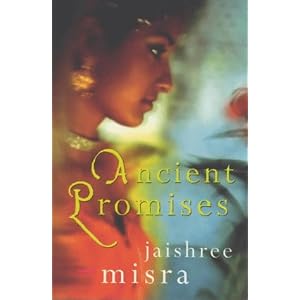
I went to the library to look for the 3rd and last book in The Hunger Games trilogy but it wasn’t there. They had to place an order for it and they said it would take a week. Even as my disappointment was taking shape my eyes fell on Jaishree Misra’s “Ancient Promises.” A summary:
Young and vulnerable, Janu gave up Arjun, her first great love, to enter into an arranged marriage. Years later she is miserable, having been gradually shut out by the coldness of her husband’s family and his indifference to her and their daughter’s needs. Finally she flees to England to escape the loveless union – but at what price to herself and those she loves?
I had heard of Jaishree Misra but this was the first time I gave into reading her book. Especially since my mom said that someone had raved about this book to her. The book begins with Janu’s marriage and then takes us a little into her past. Janu meets Arjun in college, they become friends and then lovers. Now in most parts of the world the natural progression would be to marry each other and lead a great life. But in India, being lovers comes with a sack of complications. Caste, race, religion, class and most of all parental approval comes into play. Thus is decided an arranged marriage. One which Janu goes through. Despite Arjun being the owner of her heart, Janu decides to agree to the “match” that her parents made for her. She goes through years of silent suffering before she speaks up for herself, gathers courage and even makes the decision to support herself.
A lot of the issues in this novel surface from merely being a part of Indian society and part of a household that fiercely upholds a traditional outlook. Although Janu felt rage initially, at the fact that she wasn’t involved with the search process, she didn’t voice it. Instead, she cried inside, she held hands with Arjun and parted from him with a heavy heart as he left for further studies to England. She met her future husband for 5 minutes where he asked questions and she answered. She agreed to the marriage although she could have put her foot down and refused.
Many readers would wonder what made her take this seemingly insane decision. I personally would never do it. But somewhere in a remote corner of my mind I comprehend her choice. In her letter to Arjun she explains –
Because I’m tired of fighting off my family, they’ve proven their love for me in the eighteen years it’s taken to bring me up…maybe I will find some comfort in making my folks happy for once! For a while they’ve seen my ways as being increasingly dissolute and uncaring, so here’s compensation for all that in one fell swoop. And how! I’ve never seen them happier. It’s hard not to let that infect me.
Although it has changed over the years, a lot of brides in India still get married for all the same reasons that Janu mentions. While a few marriages genuinely turn out to be good, the rest continue in a parallel existence made up of adjustments and compromises tied together by the fear of social stigma. Janu’s turns out to be one such marriage. Her husband does not abuse her or beat her. He provides for all her needs, monetarily. But he is indifferent. They do not have conversations or laugh together or share anything with each other. He is mentally remote, which makes it all the more difficult for Janu to pinpoint the reason for leaving him.
Her husband’s family, mainly the womenfolk, revels in throwing taunts at her, teasing her and generally not showing her love or kindness. In a last bid to win their affection, Janu deliberately gets pregnant. But she discovers that even her daughter fails to move them, even more so when the child turns out to have learning disabilities.
Janu eventually musters the courage to put an end to the jibes thrown at her, study and earn a degree and finally get a scholarship to go abroad to study and teach. Janu’s problems don’t end there but Misra ensures a happy ending.
What I liked in this book was the acute perception and description of a lot of issues that are faced by Indian families, particularly women, even today. This book would make particular sense to a person coming from Kerala, a state in Southern India, which is where I too come from. Many references and words from Malayalam, the language of the state, are used in the novel which might make it a little difficult for others to understand but makes a whole lot of sense to me. In fact, it’s this additional sprinkling of words from another language that gives a more definite texture to the story, immersing it firmly in the culture and customs of the place.
On the other hand, sometimes the characters can seem black and white. All the people in Janu’s in-laws family are portrayed as uncaring, scheming people. Arjun seems to be a man without flaws. Leena is the right foil to Janu, with her flirtatious and free-spirited ways. Janu’s own family is a mix of good heartedness and spirituality, weakened by tradition and societal obligations. Misra’s writing is uncomplicated and flows smoothly albeit a bit melodramatic in some places. Being a semi-autobiographical book makes it a more interesting read.
Verdict: Perfect book for a lazy afternoon
Rating: 3/5
Thanks for reviewing this book, I had never heard of it before but I think it's something I would enjoy. I like that the author didn't make her husband abusive, I've seen that in a few books about arranged marriages and it makes the issue too black and white.
ReplyDeleteWonderful review, Birdy! I have seen Jaishree Misra's books in the bookshop and the library, but haven't read one yet. I didn't know that she was from Kerala. I don't know when young people in India can take their life in their own hands and make the important decisions themselves. Sometimes culture is like a millstone around one's neck. But it is nice that a few are bringing about change in their own way and it is nice that Jaishree Misra has captured that.
ReplyDeleteSam - Thank you and sorry for answering your comment so late. I have been very tardy in my reading and commenting off late. Yes, I think you might like this, and particularly the bit about arranged marriages.
ReplyDeleteVishy - Thanks Vishy! I too didn't know she was from Kerala until I read this. What you said is so true. While other countries take pride in their culture, we use culture as a tool to restrain people from having a mind of their own. It's indeed a millstone around one's neck here. A few are definitely bringing in change but I sometimes wonder if that's good enough, especially when I read about the trials and tribulations those few go through...